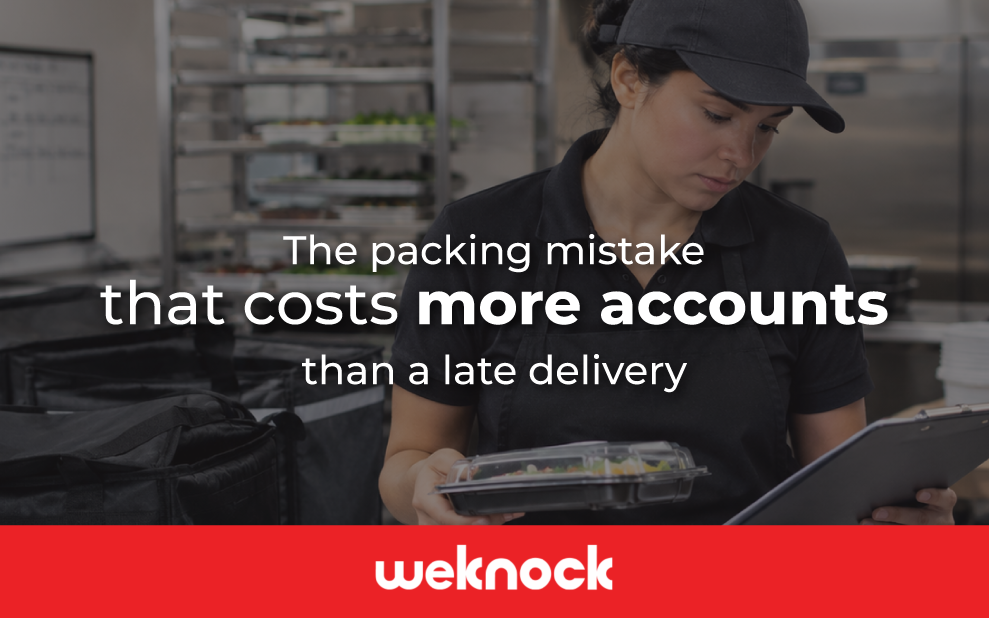
A late delivery announces itself. Everyone in the room knows the food is not there yet. The host is uncomfortable, but the problem is visible and shared.
A packing mistake is silent. The food arrived on time and looks complete. Then the client opens the boxes in front of fourteen people, and two lunches are missing.
That is one of the costliest mistakes in catering delivery, and one of the hardest to see coming. The late arrival is loud and obvious. The missing item is silent until the client finds it, which is what makes it so dangerous.
This post is a deep dive on one of the three failures covered in [the catering delivery mistakes that cost your best accounts]. Start there for the full picture. Here, we go deeper into where packing errors actually hide and the step-by-step check that catches them.
TL;DR: A packing mistake stays invisible until the worst possible moment, when the client is already in front of the room and nothing can be fixed. That is what makes a missing or wrong item one of the costliest catering failures. The only real defense is a check against the confirmed order before it leaves the building. This post breaks that check into five steps.
Why a quiet packing mistake is so dangerous
A late delivery gives off warning signs. The driver is behind, the clock is moving, and the operator usually knows before the client does. There is a window, however small, to call ahead and manage the moment.
A packing mistake gives off nothing. The order left on time and the system marked it complete. The operator has no signal that anything is wrong, because on every metric the delivery looks perfect.
So the client becomes the one who discovers it. They open the order in the room and find the gap. By then the restaurant cannot fix what it never knew was broken. A late delivery is a problem you can see coming. A packing error is a problem you hear about from the client, after it has already cost you.
Where the packing mistake actually hides
Packing errors are rarely one careless moment. They come from the conditions a catering order is built under, and they cluster in a few predictable places.
The first is the separately-staged item. A dessert, a drinks carrier, or a hot tray finishing last gets set aside to grab on the way out, and then it does not get grabbed. It was never in the main stack, so the order still looks complete without it.
The second is the multi-bag miscount. A large order is several bags and containers. Two get counted as one in the rush, and the order leaves a piece short while looking full.
The third is the substitution gap. An item runs low and gets swapped or dropped, and no one flags it. The client gets something they did not order, or nothing where they expected something.
The fourth is the highest-stakes one: the dietary or special item. The two vegetarian boxes, the gluten-free meal, the one allergy-safe plate. These are single items in a large order, easy to miss, and the most visible when they are missing, because a specific person is left with nothing.
The fifth is the last-minute add-on. The client added items after the original order, and the add-on never made it onto the pack list the kitchen worked from.
The check, step by step
A packing error has exactly one place it can be fixed: before the order leaves the building. A short count caught at the restaurant is a quick fix. The same miscount caught at the delivery address is a client standing in front of a room with missing food. Here is the check, in five steps.
Step 1. Check against the confirmed order, not memory
The source of truth is what the client actually confirmed, not the kitchen’s recollection of it. The check starts by putting the confirmed order in hand and working from that, so a missed add-on or a late change cannot slip through unnoticed.
Step 2. Count by category, not by bag
A full-looking pile is not a verified order. Reconcile by category: entrees, sides, utensils and serving supplies, beverages, and any special items. Counting by category catches the gap that a quick glance at a tall stack of bags misses.
Step 3. Verify the high-risk items first
Some items go missing far more often than others. The separately-staged dessert or hot tray, the dietary and allergy meals, and the last-minute add-ons are the usual offenders. Confirm those first, because they are the ones most likely to be absent and the most damaging when they are.
Step 4. Reconcile the piece count
Know how many bags and containers the order should be, then count what is actually leaving. A simple piece count against an expected number is the fastest way to catch the bag that got counted twice or left on the prep table.
Step 5. Do it before departure, while the fix is still free
The entire value of the check is its timing. Run it at the restaurant, where a missing tray is a two-minute correction. The same check skipped until the delivery address is not a check at all, because by then the only option is to apologize.
This is the step a delivery model built for speed skips. When a driver is racing to the next stop, the incentive is to grab the bags and go. If your catering program keeps losing accounts to missing items, our [Audit Checklist] puts this five-step check on one page.
Why the client never forgives the missing item
A late delivery, once the food finally arrives, can fade from memory. A missing item stays on display for the whole meal.
The person who placed the order is accountable for it. They ordered for fourteen and twelve arrived, so two people go without. Those two remember, and so does the host who has to explain it. It also cannot be fixed in the moment, and the discount offered the next day does not erase what the room saw.
That is why a packing error is so hard to come back from. Lateness disrupts the start of an event. A packing error sits in the middle of it, visible to everyone the client wanted to impress.
What the check protects
The cost of a packing error is never the missing tray. It is the account behind it.
A corporate client is a recurring relationship, often worth far more in a year than any single order. The missing item does not cost a few entrees. It costs every order that client would have placed after deciding the restaurant could not be trusted with the room.
Weknock assigns one trained driver per catering order, with no route stacking, who owns the order from pickup through setup. There is no next stop pulling the driver out the door before the order is confirmed whole. That is part of why the on-time rate holds at 98%. When nothing is racing the order out the door, the check gets run and the order leaves complete.
If you want catering delivery where the order is confirmed whole before it leaves, [talk to our team].
Why is a wrong or incomplete catering order worse than a late one?
A late delivery is visible early and to everyone, so the operator often has a chance to manage it. A packing error stays hidden until the client opens the order in front of the room, when nothing can be fixed. The missing item is also on display for the whole meal, while a late delivery fades once the food arrives. That visibility at the worst moment is what makes packing errors so costly.
What causes packing errors on catering orders?
Most packing errors come from the conditions, not a single mistake. They cluster in predictable places: a separately-staged item left behind, two bags counted as one, an unflagged substitution, a missed dietary or allergy item, or a last-minute add-on that never reached the pack list. Each one looks complete in the moment and surfaces only when the full order is opened at the delivery address.
How do you prevent missing items on catering deliveries?
Run a five-step check before the order leaves the restaurant: verify against the confirmed order, count by category, confirm the high-risk items first, reconcile the piece count, and do it all before departure while a fix is still free. Catching a short count at the kitchen turns it into a quick correction instead of a client-facing failure. A delivery model that is not rushing to a next stop has the time to make that check.
How does Weknock reduce wrong and incomplete catering orders?
Weknock assigns one trained driver per catering order, with no route stacking, who owns the order from pickup through setup. Because the driver is not racing to a stacked next stop, there is time to confirm the order is complete before leaving. Across more than 3.5 million deliveries since 2014, that model holds a 98% on-time rate for more than 180 Florida restaurants.