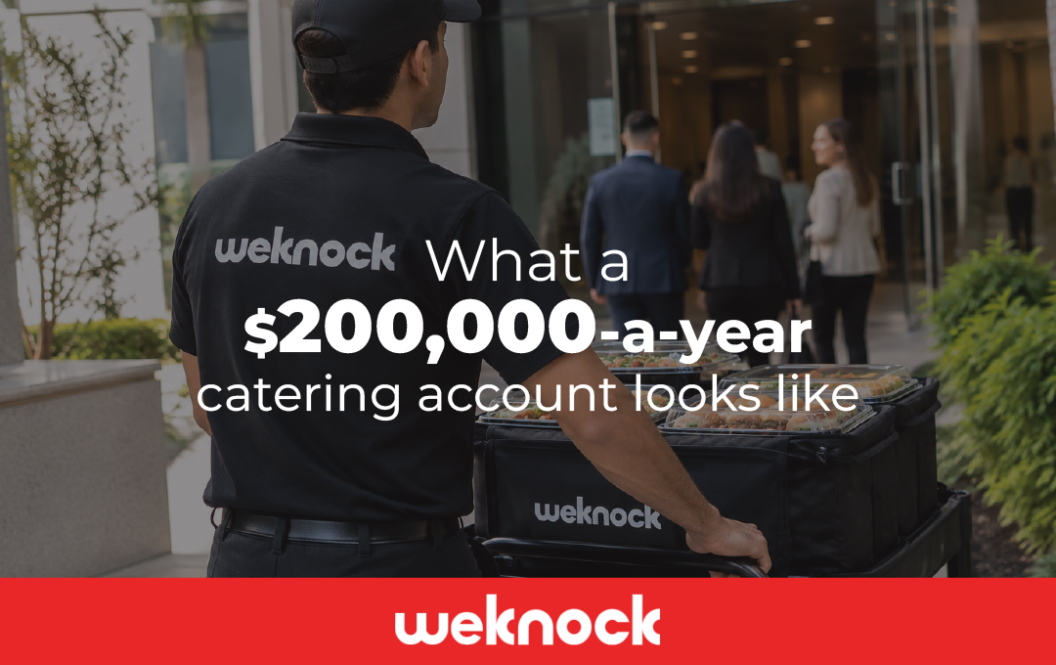
The biggest catering account a restaurant has is rarely its biggest order. It is its most consistent one.
Weknock is a B2B catering delivery logistics company that has worked with Florida restaurants since 2014, and the largest accounts share a shape. At the top end, a single recurring catering customer can represent $200,000 a year in orders. That number does not come from one enormous event. It comes from a standing relationship that kept ordering, week after week, because every delivery held up.
TL;DR: A $200,000-a-year catering account is not a whale that places giant orders. It is a corporate client that orders constantly and never had a reason to stop. The largest accounts are built from repetition, and repetition is built on reliability. This is the anatomy of how a one-off order becomes a six-figure account.
Why a $200,000 catering account is repetition, not size
A $200,000 account sounds like a series of huge orders. It usually is not.
Corporate clients order at very different cadences. Some book twice a week, some daily, and a pharma rep running lunches across several practices can order more than once a day. A client ordering at the high end of a typical corporate range, several hundred dollars a delivery, multiple times a week, reaches six figures over a year without a single event that looks remarkable on its own.
The lesson is that the account, not the order, is the prize. One delivery is a few hundred dollars. The relationship behind it, compounded across a year, is the number that matters.
It started with one order
No six-figure account began as one. It began as a single order that went right.
A corporate buyer placed a first order, watched it arrive on time and complete, and learned they could trust it. That first delivery was an [audition], and passing it earned the second order, then the third. The account grew because nothing ever gave the buyer a reason to look elsewhere.
This is why the biggest accounts cannot be bought with a discount or a bigger menu. They are earned one reliable delivery at a time, and they compound only as long as the reliability holds.
How the account expands
A standing account does not just repeat. It grows, in a few predictable directions.
It grows in frequency. A weekly lunch becomes two, because the team trusts it and the buyer has one less thing to manage.
It grows in scope. The department that ordered for its own meetings starts ordering for company-wide events, then for client visits, then for the office next door.
It grows in commitment. Ad-hoc reorders become a standing schedule, and a standing schedule becomes the account that anchors the restaurant’s catering revenue. Each step depends on the last one having gone right.
What makes it grow, and what caps it
Reliability is the multiplier on the whole account. Every flawless delivery is a reason to give the restaurant more volume. Every failure is a reason to give it less.
A single bad delivery rarely ends a six-figure account outright, but it caps it. The buyer who got burned stops expanding the relationship and starts keeping a backup. The account that could have grown to $200,000 plateaus at a fraction of it, and the restaurant never knows what it left on the table.
That is why the delivery partner matters as much as the food. The restaurant’s reliability is what lets a buyer keep consolidating volume onto one provider instead of spreading the risk. Weknock assigns one trained driver per catering order, with no route stacking, and holds a 98% on-time rate on everything from a few hundred dollars to single catering deliveries past $9,000. That consistency is what allows an account to keep growing instead of stalling out.
If you want a clear path for growing your largest accounts, our [Scale Playbook] lays out how recurring accounts compound.
The account you already have
The next six-figure account is probably not a prospect you have to win. It is a client already ordering from you, who could order far more if every delivery earned it.
The largest accounts are grown, not landed. They reward the restaurant that treats a single Tuesday lunch like the standing program it could become.
If you want catering delivery reliable enough to grow your biggest accounts on, [talk to our team].
How much is a large corporate catering account worth?
At the top end, a single recurring catering customer can represent $200,000 a year in orders. That figure comes from frequency, not from unusually large individual orders. A corporate client ordering several times a week at the high end of a typical order value reaches six figures over a year through repetition.
How do catering accounts grow into large recurring clients?
They grow in three directions: more frequent orders, wider scope across departments and event types, and a firmer commitment to a standing schedule. Each step depends on the previous deliveries having gone right. Reliability is what lets a buyer keep consolidating more volume onto one provider.
Why do some catering accounts stop growing?
Usually a delivery failure caps them. A single bad delivery rarely ends a large account outright, but it makes the buyer stop expanding the relationship and start keeping a backup provider. The account plateaus at a fraction of its potential, and the restaurant often never learns why.
What is the best way to grow a corporate catering account?
Deliver flawlessly, every time, so the buyer has a reason to give you more volume and no reason to look elsewhere. Reliability is the multiplier on a recurring account. Combined with a frictionless reorder and a standing schedule, consistent delivery is what turns a single order into a six-figure client.