Most one-off catering orders are treated as a sale. The order comes in, the food goes out, the transaction closes. Then the restaurant waits for the next one to appear on its own.
The accounts that matter do not work that way. A single corporate order is not a transaction. It is an audition for a standing account, and the gap between the two is worth more than most operators count. Weknock is a B2B catering delivery logistics company that has worked with Florida restaurants since 2014, and the pattern is consistent. The largest accounts almost never started large. They started with one order that went right.
TL;DR: A one-off catering order and a recurring account are not the same customer at different sizes. They are two different relationships, and the second is worth far more. This post covers what a recurring account is actually worth over a year, and the step-by-step path from a first order to a standing program.
What a recurring account is actually worth
The single order is the smallest version of the number. The recurring account behind it is the real one.
Corporate clients order at very different cadences. Some book twice a week. Some order daily. A pharma rep running lunches across several practices can order more than once a day. At the top end, one recurring catering customer can represent $200,000 a year in orders.
Most accounts are smaller than that, but even a modest weekly client compounds into tens of thousands over a year. The value was never in the single order. It is in the repetition, and the repetition is what most operators leave on the table.
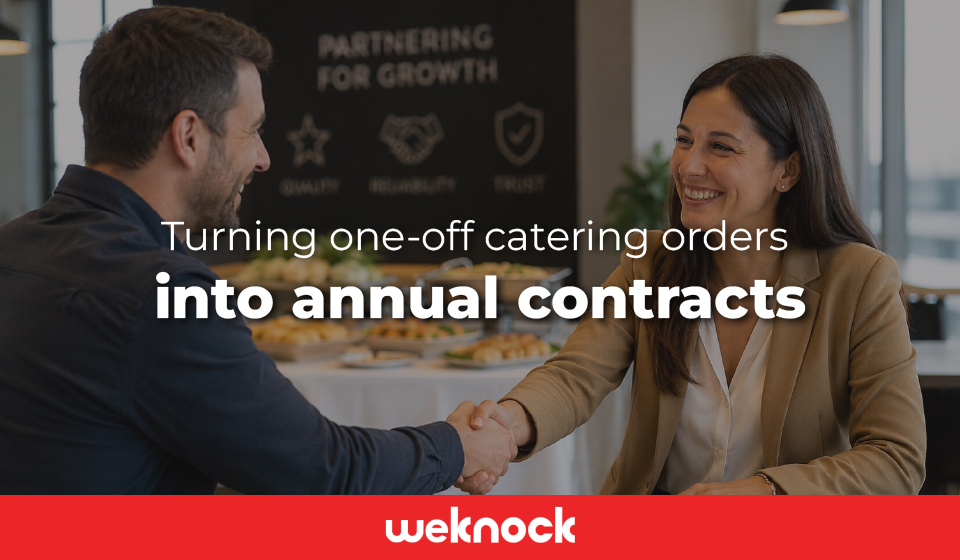
Why one-off catering orders are the audition
A corporate buyer placing a first order is testing you, whether they say so or not. They have a meeting, a budget, and their own reputation riding on whether the food shows up right.
If it does, you have not made a sale. You have passed an audition. The buyer now knows you can be trusted with the next one, and the one after that.
If it does not, there is no next order, and you rarely find out why. That is why the first order is the most important one, not the biggest one. Treat the small first order like the standing account it could become.
How a one-off becomes a standing account
The path from a single order to an annual program is short, but each step has to happen on purpose.
The first step is to deliver the first order flawlessly. Reliability is the entire pitch. A buyer who got exactly what they ordered, on time and set up right, has every reason to call again and none to look elsewhere.
The second step is to follow up. The reorder rarely happens on its own, because a busy buyer forgets a vendor that does not stay in view. A short, specific follow-up after the event opens the door to the next order without a hard sell.
The third step is to remove friction from reordering. Same contact, same process, remembered preferences. The easier it is to reorder, the more often they do.
The fourth step is to name the pattern. When a client orders every Thursday, propose a standing Thursday order. You are not selling them anything. You are saving them a recurring task.
The fifth step is to move to a committed schedule. Once the pattern holds, a standing weekly or monthly program turns ad-hoc reorders into a predictable account, for them and for you.
Why reliability is the precondition
None of these steps work if the delivery is not reliable. You cannot ask a client to commit to a weekly schedule on a delivery that might fail.
A standing account is a standing risk if every delivery is a gamble. The reason large accounts consolidate around one provider is that the provider removed the gamble. Predictability is what they are actually buying.
Weknock assigns one trained driver per catering order, with no route stacking, who owns the order from pickup through setup. It holds a 98% on-time rate, and across the more than 180 restaurants Weknock has served since 2014, plenty of the largest accounts started exactly the way this post describes. That is the reliability that turns a first order into a tenth.
If you want a clear path from single orders to standing accounts, our Convert Guide lays out the steps in order.
The math favors the long game
Chasing new one-off orders is expensive and never ends. Converting the orders you already win into recurring accounts is where the leverage is.
One retained client ordering weekly is worth more than a dozen one-offs, and it costs almost nothing to acquire. The account is already in the door. The work is keeping it there.
If you want catering delivery reliable enough to build standing accounts on, talk to our team.
How do you turn a one-time catering order into a recurring account?
Deliver the first order flawlessly, follow up after the event, make reordering frictionless, and propose a standing schedule once a pattern emerges. The first order is an audition for the account behind it, so reliability on that order is what earns the second. The conversion is a sequence of deliberate steps, not a single sale.
What is a recurring corporate catering account worth?
It depends on cadence and order size, which vary widely. Some clients book twice a week, some daily, and some more than once a day. At the top end, a single recurring catering customer can represent $200,000 a year in orders. Even a modest weekly account compounds into tens of thousands of dollars over a year.
Why do one-off catering clients not reorder on their own?
A satisfied client is still a busy one. Without a follow-up, the restaurant fades from view and the reorder competes with everything else on the buyer’s plate. The order that never came back was often lost to inertia, not dissatisfaction, which is why follow-up matters as much as the delivery itself.
What makes a corporate client commit to a standing catering schedule?
Consistency they can count on. A client commits to a recurring schedule when the delivery has proven reliable enough that booking it no longer feels like a risk. One accountable driver, on-time delivery, and a frictionless reorder process turn an ad-hoc buyer into a standing account.